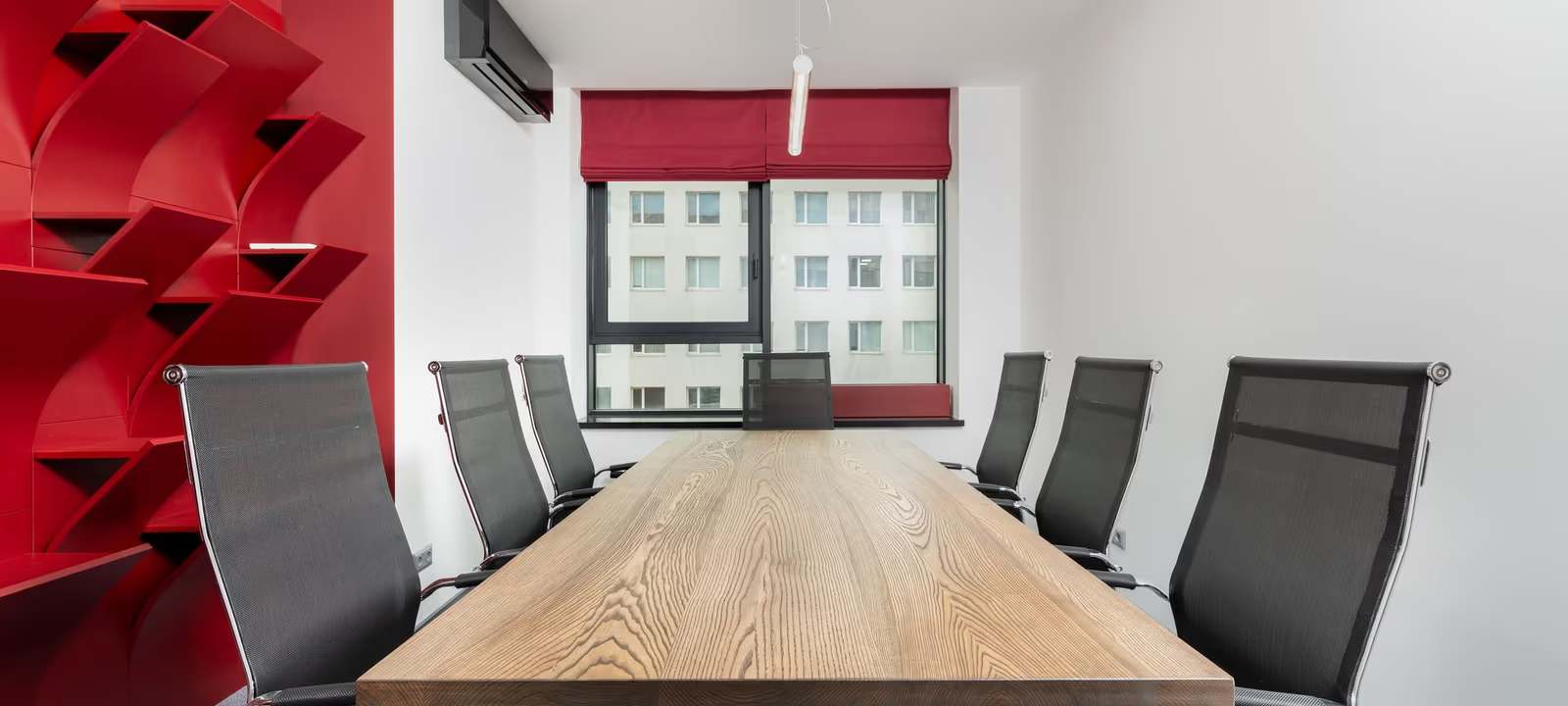
A strategy offsite staffed only by the people who wrote the strategy reproduces the assumptions it was called to test. An outside operator who has already run the play you are debating changes that, but only if they are scheduled before the decision session rather than as a closing speaker.
Why bring outsiders to an offsite?
Because the room otherwise contains only people who will be measured against the plan. That is a structural limit on challenge rather than a failure of courage, and no amount of facilitation removes it.
An operator who has run the same play somewhere else has no stake in the outcome and specific knowledge of how it went. That combination is difficult to source internally at any level of seniority, which is the same argument for a standing advisory board.
- 01
Name the assumption
State the single assumption the session exists to test, in writing, before inviting anyone.
- 02
Find who has tested it
Select operators on relevant recent experience of that lever, not on seniority.
- 03
Schedule early
Place them before the decision session, never as a closing keynote.
- 04
Capture disagreement
Record the conditions under which the plan fails, not a summary of the discussion.
Who should be in the room?
People who have operated the specific lever under discussion at comparable scale — not the most senior person available. Seniority buys credibility in the room; relevant operating experience buys useful disagreement, and they are not the same purchase.
Recency matters as much as relevance. Someone who ran the play five years ago is describing a different competitive and regulatory setting.
Where in the agenda do they sit?
Before the decision session. An operator scheduled as a closing keynote is entertainment; the decisions have been made and the session functions as validation. Running it from a written proposition avoids that.
Placed early, the same person changes what gets decided, because the group is still forming a view and has something concrete to form it against.
| Insider-only | Operator-augmented | |
|---|---|---|
| Tests | The internal logic of the plan | Whether the plan survived somewhere else |
| Challenge is bounded by | Everyone being measured against the plan | Nothing — the operator has no stake |
| Fails when | Nobody in the room has run the play | The operator is scheduled as the closing speaker |
What preparation does it require?
More than an expert call does. The operator needs the assumption in advance and enough context to challenge it specifically rather than generally, which means sharing something about your situation before the session.
A briefing sent the night before produces general commentary, which is the most common way this format disappoints and the easiest to avoid.
What happens after they leave?
Capture the disagreement, not the consensus. A workshop that produced agreement has usually produced politeness, and the useful output is the specific point at which an experienced operator said the plan would not survive.
Writing that down as a condition — what would have to be true for the plan to work — converts a session into something the team can test later, which is how a planning assumption becomes checkable.
Naming who owns each condition is what converts the output into work. A condition with no name against it is an observation, and observations do not survive the return to normal operations. The person who raised it is usually the right owner, because they already believe it matters and will notice if it turns out to be true. A short list with names attached outlasts a long list without them.